
Amendment or Notification? Managing Changes to Clinical Study Documents

Clinical study protocols and informed consent forms (ICFs) are important documents that provide key information for both study staff and participants. As studies progress, revisions to these documents may be required for a wide variety of reasons, including updating safety assessments based on new safety information, adjusting eligibility criteria to improve recruitment, or clarifying a discrepancy. In all of these cases, it is important to understand how to navigate the process of revising a study document. Which regulatory pathways are required to approve and implement this change? What types of revision documents need to be prepared, and how is that decision made? This article will aim to answer these questions and clarify the protocol and ICF revision process.
Ethics Board and Regulatory Submission Pathways for Revisions
Changes to clinical study documents including protocol and ICF cannot just be made on a whim. They typically first require submission and review by the ethics board and regulatory authorities that provided initial approval for the study documents.
Prior to implementation, any modification to research activities or changes to an IRB-approved protocol or study document must be submitted to the IRB for review and approval, as applicable. Such changes may range from minor administrative updates, such as a change to the site’s contact information, to substantive protocol amendments, such as modifications to the dosing regimen or the addition of a new study objective.
An exception applies when a change is necessary to eliminate an immediate hazard to study participants. In such circumstances, the change may be implemented without prior IRB approval but must be reported to the IRB promptly following implementation, in accordance with the applicable IRB’s reporting requirements and timelines. Reporting timelines may vary among IRBs; therefore, the requirements of the reviewing IRB should be followed.
All changes to the ICF or other consent material require approval from the IRB before implementation.
Regulatory submission is also usually required for revisions to study documents. Different countries and jurisdictions have their own regulatory authorities with specific regulatory pathways for submission of revised documents. For studies done in Canada, revised documents are submitted to Health Canada (HC), the federal regulatory authority for clinical studies done in Canada, which offers different pathways by which revisions can be made.
For changes to the study drug and/or protocol that affect participant safety or affect analysis and interpretation of the safety and efficacy of the investigational drug, a Clinical Trial Application (CTA)-Amendment, or CTA-A, must be submitted. More specifically, CTA-As are filed when a revision:
- Affects the selection, assessment, or dismissal of a participant, or alters the risk to the health of the participant
- Affects evaluation of safety or clinical efficacy of the study drug
- Extends duration of treatment
Examples of changes that require a CTA-A include (but are not limited to): prospective changes to eligibility or dismissal criteria, tests, or procedures; changes in ongoing criteria, tests, or procedures that assess safety or efficacy; updates to the study design, population, duration of use, objectives, or hypotheses; and adjustments to study drug’s dose level, dosage schedule, or treatment duration.
Notably, if an amendment needs to be made immediately to address an urgent risk to participants or other persons due to the trial or study drug, these changes can be made without prior HC review. However, HC must be notified within 15 calendar days of the change being implemented with rationale provided, and a CTA-A and IRB submission must still be submitted. Outside of these cases, a No Objection Letter (NOL) must be received after HC review to implement the amendment.
For revisions that do not meet the criteria for a CTA-A, a CTA-Notification (CTA-N), is submitted instead. These submissions are filed when a revision:
- Does not affect safety of the participant and would not be considered for a CTA-A
- Pertains to changes in chemistry or manufacturing of the study drug, but does not affect study drug quality or safety
For CTA-Ns, HC provides examples of revisions that are administrative in nature, but also minor changes that are safety-favourable (e.g., adjusting laboratory cut-off values, adding new drug safety information to the ICF). Other specific cases may also require a notification, such as submitting refusals from other regulatory authorities following authorization of CTAs or early discontinuation of a trial.
In the case where a CTA-N aligns with the HC guidance, the applicable change may be implemented immediately; however, HC must be notified within 15 calendar days of the date the change is implemented. Upon receipt of the CTA-N, HC typically issues an automated acknowledgement confirming receipt of the submission; no formal approval or NOL is issued for a CTA-N.
Types of Changes and Revision Documents
Before ethics and regulatory submission, updates to the protocol and ICF are addressed using different types of revision documents, such as amendments, notifications, addenda, and memo-to-files. In order to understand what type of revision is most appropriate, it is important to first understand what kind of change is being made, what impact the change has on the study, and which documents require updates.
Below is a table of revision types generated by BPSI, what they are generally meant to address, and their requirements for approval from IRBs and HC:
|
Type |
Document |
Details of revision |
|
Amendment |
Protocol and/or ICF |
▪ Non-administrative study changes (e.g., to study design, sample size, study or washout duration, drug name, route of administration, study conduct, participant safety, safety monitoring) ▪ A new version of the protocol and/or ICF is generated |
|
Protocol notification |
Protocol |
▪ Administrative changes (e.g., sample processing instructions, bioanalytical lab, sample analysis procedures, contact information, addresses, adverse event reporting) ▪ Important clarifications and typographic corrections |
|
ICF addendum |
ICF |
▪ Changes to ICF usually after participant has already consented ▪ Substantive changes to ICF may require an amendment |
|
Memo-to-file (MTF) |
Protocol |
▪ Non-consequential clarifications and typographic corrections |
Protocol or ICF amendment: For non-administrative changes to the study protocol, an updated version of the protocol and/or ICF is required, along with a rationale for the change. Amendments usually require regulatory and ethics approval, but this is dependent on the changes made, documents updated, and regulatory submission pathway taken.
Protocol notification: For administrative changes, clarification of inconsistencies, and/or correction of typographical errors that may affect the understanding of study conduct, study procedures, or safety monitoring, a protocol notification can be prepared. They should not be used to introduce any non-administrative, non-corrective changes to the protocol. These documents require submission to notify IRBs and regulatory agencies of revisions made.
For changes that clearly meet the criteria for a CTA-N, a protocol notification is the recommended approach. This pathway is sufficient to meet the applicable regulatory and ethical requirements, avoids unnecessary review timelines, and allows the change and associated documentation to be implemented more efficiently.
If preferred, the sponsor may document minor or administrative changes through a protocol amendment rather than a protocol notification. However, preparing the change as a protocol amendment does not change its regulatory classification. If the nature of the change qualifies as a CTA-N, it would still be submitted to Health Canada as a CTA-N rather than as a CTA-A.
ICF addendum: As per ICH E6(R3), participants must be informed of any new information relevant for continued participation. For changes to an approved ICF, particularly when participants have already consented and signed the ICF, an addendum is a supplementary document that includes only the changes introduced in the current ICF revision. This approach reduces paperwork and provides a clear and concise way to share any new information or changes with the participant and obtain signed consent acknowledging these changes. For more consequential changes or when a change is made for an unconsented dosing cohort, an ICF amendment may be more appropriate than an addendum.
Memo-to-file (MTF): A MTF is used to document clarifications or correct typographic errors that do not have any effect or implication on participant safety, rights, data integrity, or study conduct. MTFs are filed with other study essential records and usually do not require submission or approval, but they cannot be used for prospective changes made to approved protocol language or procedures and should not alter the original intent in the protocol.
The type of revision required is determined on a case-by-case basis and is usually decided in conjunction with the regulatory pathway taken. This decision process (delineated in the flowchart below) starts with evaluating the impact and nature of the change.
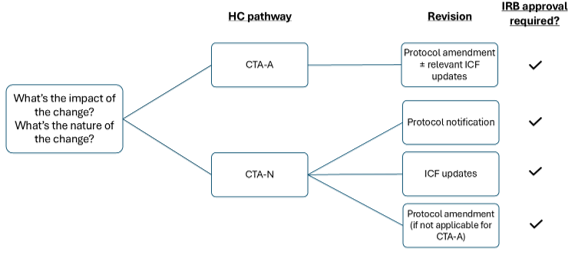
Does the change affect the safety, rights, or eligibility of the participant, or could it affect data integrity or study conduct as a whole? Is it mostly administrative in nature or made to clarify or correct an inconsistency? Which study documents are affected? What are the current study timelines? The answers to these questions help inform the selection of the regulatory pathway and the type of revision document that is most appropriate for implementation of the required changes.
Experience and Expertise with Document Revisions at BPSI
BPSI provides expertise and support throughout all parts of protocol and ICF writing, including the preparation of study document revisions and submission to IRBs and regulatory authorities. Our experienced Scientific Medical Writing team operates with a dynamic and flexible approach, accommodating for any changes requested and addressing any issues as needed. All revisions undergo thorough review in collaboration with relevant teams and the sponsor, as these revised documents represent the most up-to-date text or version of the protocol or ICF. This ensures that these clinical study documents are properly updated in a timely manner, which is crucial for maintaining participant safety, study conduct and integrity, and ethical and regulatory compliance.
References
-
Health Canada. Guidance Document: Part C, Division 5 of the Food and Drug Regulations “Drugs for Clinical Trials Involving Human Subjects” (GUI-0100). Version 4. Published August 14, 2026. Accessed September 21, 2026. https://www.canada.ca/content/dam/hc-sc/documents/services/drugs-health-products/compliance-enforcement/good-clinical-practices/guidance-documents/guidance-drugs-clinical-trials-human-subjects-gui-0100/guidance-drugs-clinical-trials-human-subjects-gui-0100.pdf
-
Health Canada. Guidance Document for Clinical Trial Sponsors: Clinical Trial Applications. Published May 29, 2013. Revised March 17, 2016. Accessed September 21, 2026. https://www.canada.ca/en/health-canada/services/drugs-health-products/drug-products/applications-submissions/guidance-documents/clinical-trials/clinical-trial-sponsors-applications.html Canada.ca
-
International Council for Harmonisation of Technical Requirements for Pharmaceuticals for Human Use. ICH Harmonised Guideline: Guideline for Good Clinical Practice E6(R3). Final version. Adopted June 16, 2026. Accessed September 21, 2026. https://database.ich.org/sites/default/files/ICH%20E6%28R3%29_Step4_FinalConsolidatedGuideline_2026_0616_.pdf
-
Canadian Institutes of Health Research; Natural Sciences and Engineering Research Council of Canada; Social Sciences and Humanities Research Council. Tri-Council Policy Statement: Ethical Conduct for Research Involving Humans—TCPS 2 (2022). Accessed September 21, 2026. https://ethics.gc.ca/eng/documents/tcps2-2022-en.pdf ethics.gc.ca
-
US Food and Drug Administration. Informed Consent Guidance for IRBs, Clinical Investigators, and Sponsors. Published August 2023. Accessed September 21, 2026. https://www.fda.gov/media/88915/download
Written By:
Matthew Wong, PhD